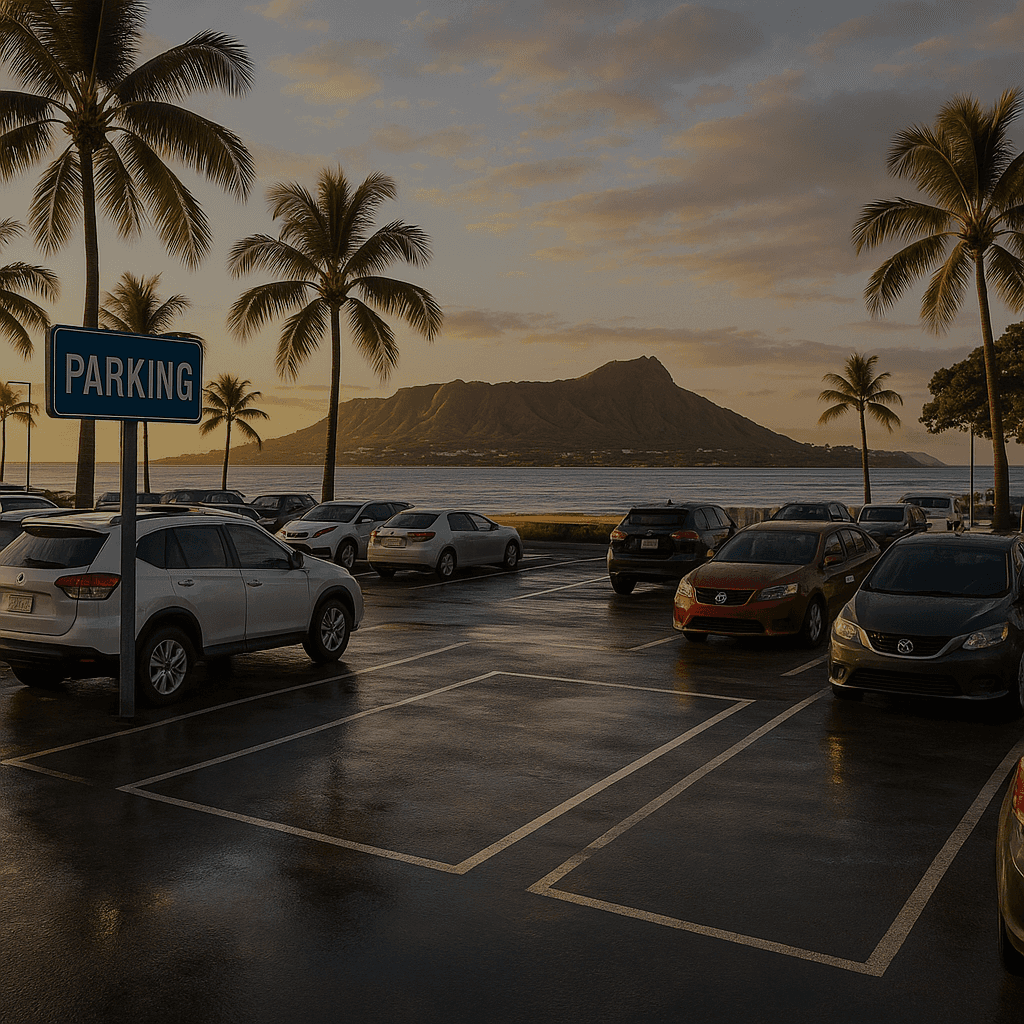

Waikiki squeezes hotels, beaches, shops, and restaurants into a compact stretch of Honolulu, and most visitors barely touch their car once they park. That changes the charging math for EV drivers. You are not planning a long highway run between fast chargers. You are hunting for one reliable stall within walking distance of your room, and you want it open when you come back from the beach.
Chargers do exist in and around the resort district, but they are spread out and demand runs high. A little planning before you land saves a lot of circling. Here is where to look, what charging costs in Honolulu, and how to keep your battery topped up without losing your parking spot.
Three crowd-sourced and network maps come up again and again for Honolulu drivers: PlugShare, ChargeHub, and ChargeFinder. Each lets you browse a map, filter by charging speed, and see what other drivers reported about a specific stall. PlugShare’s directory lists 52 free EV charging stations and 684 total charging stations in Urban Honolulu, which gives you a sense of the overall supply across the city.
Use more than one map before you commit to a plan. Listings go stale, stations go offline, and new ones show up without much notice. Cross-check the same location on two maps and read the most recent check-ins. If the last report is months old, treat that stall as a maybe rather than a sure thing.
Hotels are the most convenient option because you can charge while you sleep. Marriott Bonvoy lists EV charging at a variety of its Waikiki properties, which makes the brand a reasonable starting point if you have not booked yet. Beyond that, availability varies widely by property.
The Outrigger Waikiki Beach Resort at 2335 Kalakaua Ave shows up on ChargeFinder with a ChargePoint station that has a single outlet. One outlet is workable if the timing lines up, but it is not a guarantee. If that stall is taken, you need a backup plan before you drive over.
Before you book, call the property directly and ask three questions: Is charging available to non-guests, is it included in the resort or valet fee, and is there a time limit or idle fee once the car is full? Some stalls sit behind valet, which means you hand over the keys rather than plug in yourself. Others are first come, first served in a shared garage. Getting those answers ahead of time beats discovering them at 10 p.m. with a low battery.
A Yelp search for charging stations near Waikiki turns up a recognizable mix: Shell Recharge, Ala Moana Center, Tesla Destination Charger, and Royal Hawaiian Center. Ala Moana Center is not inside Waikiki proper, but it sits close enough to be a practical stop on the way in or out, and shopping centers often have more stalls than a single hotel garage.
One spot drivers mention repeatedly is International Marketplace, above the Tesla store. A Reddit thread on charging in Waikiki and Honolulu reports Tesla chargers there that are free, though the poster was not certain whether they are Superchargers. That uncertainty matters. Tesla Destination Chargers and Superchargers are different experiences with different speeds and different access rules, so confirm on site or in the Tesla app before you build your day around it.

Public charging in Honolulu comes from a mix of networks, and the Hawaiian Electric DCFC stations on Oahu are the ones with published rates. Beyond that, you will see destination chargers at resorts and retail centers, network stations under brands like Shell Recharge and ChargePoint, and a long tail of smaller locations scattered across the city.
Because the supply is fragmented, the practical move is to pick two or three candidate locations near your hotel and rank them. Your first choice is the one closest to where you are sleeping. Your second is a retail center where you would shop anyway. Your third is a fallback that is less convenient but more likely to be open.
Costs vary by network and time of day. At Hawaiian Electric DCFC stations on Oahu, the published daytime rate is $0.17 per kWh between 9 a.m. and 5 p.m., and the rate rises to $0.34 per kWh outside that window. That spread is large enough to change how you plan a charging session. If your schedule is flexible, a daytime session can cost meaningfully less than an overnight one at the same station.
Hotel charging works differently. Some properties fold it into a resort fee, some bill through the network app, and some offer it free to guests. Ask before you assume, because a complimentary charger changes the value of the room rate.

Charging speed determines how you use a stall. A slow charger paired with a long beach day works well. A slow charger paired with a 30-minute errand does not.
Level 2
Slower charging that suits long stays, overnight parking, or a full day away from the car
Hotel and resort garages, retail center parking structures
DC fast charging (DCFC)
Much quicker sessions, better for a short stop than an overnight stay
Public network stations, including Hawaiian Electric DCFC locations on Oahu
Destination charging
Convenience charging tied to a business, often for customers or guests
Tesla Destination Chargers and similar setups at resorts and shopping centers
Match the charger to the length of your stop. If you are leaving the car for eight hours at a hotel, a Level 2 stall is perfect and frees up fast chargers for drivers who need a quick top-up.
Free charging exists in Honolulu. PlugShare counts 52 free stations in Urban Honolulu, and the International Marketplace Tesla chargers are reported as free in a local Reddit thread. Free is never guaranteed, though. Stalls with no cost attached attract the most competition, and they are often the first ones taken.
Free stalls also tend to come with conditions. Some are reserved for customers of a specific business. Some carry posted time limits. Some sit in garages where you still pay to park even if the electricity is free. Read the signage at the stall and treat any free listing as a bonus rather than the foundation of your plan.
Arrive with a buffer. Do not roll into Waikiki on a near-empty battery and hope a stall is open.
Line up two backups for every charger you plan to use.
Ask your hotel whether valet handles the plug or whether you plug in yourself.
Check for idle fees and time limits so a full battery does not turn into a charge.
Move your car when charging finishes if the stall is in demand.
Keep your own charging cable in the car in case a station requires it.
Charge during the cheaper daytime window at Hawaiian Electric DCFC stations when your schedule allows.
Recheck your chosen station on the map app the morning you plan to use it.

Every charging decision in Waikiki is really a parking decision. A charger you cannot park at is useless, and a cheap parking spot with no outlet nearby means a separate trip to fuel up. The drivers who have the easiest time are the ones who solve both at once: pick a garage or lot near their hotel, confirm a charger sits inside it, and know what that spot costs per day.
If you are weighing options, it helps to understand the broader parking picture before you commit to a stall. Waikiki has free and low-cost alternatives around Ala Wai Boulevard, the Honolulu Zoo, Waikiki Shell, and Ala Wai Boat Harbor, but those spots are not charging locations, so you may still need a separate session. A local parking map that shows where the affordable stalls are can narrow the search faster than driving block by block.
Property owners with unused stalls have a different version of the same problem. Empty spaces near the resort district represent revenue, whether through a QR-code self-parking setup or a valet arrangement. Adding a charging option is one more reason a driver picks your lot over the one next door.
Yes, free stations exist. PlugShare lists 52 free EV charging stations in Urban Honolulu, and drivers on a local Reddit thread report free Tesla chargers at International Marketplace above the Tesla store. Free stalls fill quickly, may be limited to customers or guests, and sometimes sit inside paid parking garages, so treat them as a bonus rather than your primary plan.
Tesla Destination Chargers appear on lists of charging stations near Waikiki, and drivers report Tesla chargers at International Marketplace that may be free. Whether those units are Destination Chargers or Superchargers was not confirmed by the poster, so check the Tesla app for current status, speed, and access rules before you rely on a specific location.
Costs vary by network and time of day. At Hawaiian Electric DCFC stations on Oahu, the published rate is $0.17 per kWh from 9 a.m. to 5 p.m. and rises to $0.34 per kWh outside that window. Hotel charging may be free, bundled into a resort fee, or billed through a network app, so confirm with the property.
Several do. Marriott Bonvoy lists EV charging at a variety of its Waikiki hotels, and the Outrigger Waikiki Beach Resort at 2335 Kalakaua Ave shows a ChargePoint station with a single outlet. Availability is limited, so call ahead to ask whether charging is included, whether it is valet-only, and whether time limits apply.
There are map apps for finding chargers near your hotel, but they mostly show you where a charger is — not whether it’s actually working or what it costs. Cross-check any listing against a second source and check how recent the reports are, because stations go offline all the time.
If you want the parking side sorted before you arrive — cheap lots, hotel parking fees, and the low-cost alternatives most visitors miss — grab the downloadable Waikiki parking guide. It won’t replace a live charger map, but it’ll save you from the $40–50 valet fee while you’re out finding one.